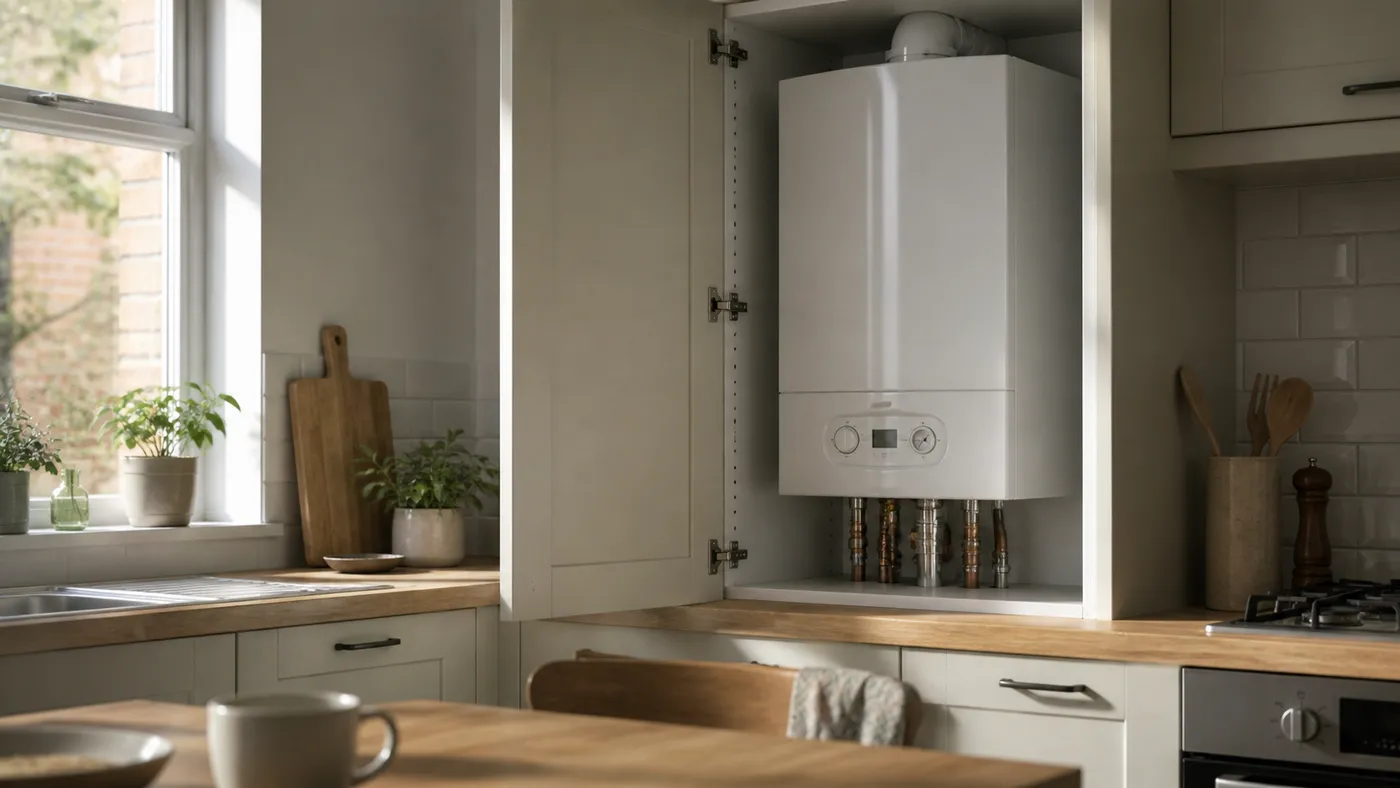
Combi sizing rules do not carry over to system and regular boilers. With a cylinder in the picture, the heat loss of the house sets the size.
A system or regular (heat-only) boiler is sized mainly to the heat loss of your home, with an allowance for reheating the hot water cylinder. Unlike a combi, it does not need a large output to heat running water instantly, so the right figure for the same house is often noticeably lower than a combi rating. The only reliable way to set it is a heat loss calculation on survey; rules of thumb give a starting point and nothing more.
Why system and regular boilers are sized differently from combis
A combi's size is driven by hot water on demand, which needs a lot of power for a short time. A boiler that heats a cylinder is sized to the heating load, because the cylinder stores hot water in advance.
That is why combi size charts, which are built around bathroom count and flow rate, can overstate what a system or heat-only boiler needs. The boiler size calculator on this site starts from the common rule of roughly 1.5kW per radiator plus an allowance for hot water. For a boiler with a cylinder, treat the radiator part as the useful estimate and the hot water part as a separate question about cylinder recovery, covered below.
Heat loss is the number that sets the size
The boiler needs enough output to replace the heat your home loses on a cold day. That is calculated, room by room, from the building itself.
A proper heat loss calculation looks at each room's size and ceiling height, what the walls, floors and roof are made of, how much insulation there is, the size and glazing of the windows, and the temperature each room is designed to reach. Two London houses with the same number of bedrooms can have very different heat losses: a solid-walled Victorian terrace with original sash windows loses heat much faster than a similar-sized house with cavity insulation and double glazing. Radiator count is a proxy for this, and a rough one.
The radiators matter too. New condensing boilers save most gas when they run at lower flow temperatures than old boilers typically did. If the existing radiators are only just big enough at a high flow temperature, the survey should say so, because a room whose radiator is undersized for its heat loss will not be fixed by a bigger boiler. It needs a larger radiator, or better insulation, in that room.
How the hot water cylinder affects boiler size
The cylinder affects how quickly hot water recovers, not whether you get it. A bigger boiler output reheats the cylinder faster, up to the limit of the cylinder's coil.
In practice, the boiler's output is shared between the heating and the cylinder. On a typical controls layout the two can run together, or hot water can take priority for a short spell. Engineers usually add a margin for cylinder reheat rather than a large fixed figure, and the cylinder's own coil rating caps how much of the boiler's output it can actually absorb. If the household runs through a full cylinder every morning and evening, the answer is often a better-sized cylinder rather than a much bigger boiler. The hot water cylinder sizing guide covers the litre side of that decision.
Why you should not just copy the old boiler's kW
Older regular and system boilers were very often oversized, and many homes have been insulated or re-glazed since. Matching the old rating repeats the old mistake.
An oversized boiler reaches temperature quickly, switches off, and starts again soon after. That short cycling wastes gas, adds wear and stops a condensing boiler from spending time in its efficient condensing range. Loft insulation, new windows, an extension or a loft conversion all change the heat loss, in either direction. If an installer's recommendation differs a lot from what you have now, ask to see the working; what to do if your installer recommends a bigger boiler than expected covers the questions to ask.
Minimum output matters as much as maximum
A boiler's lowest firing rate decides how well it behaves on mild days, which is most of the heating season. A wide modulation range usually matters more than a few extra kilowatts at the top.
On a spring evening a house might need only a small fraction of its design heat load. A boiler that can turn itself down close to that figure runs steadily; one whose minimum output is well above it cycles on and off. When comparing models of similar maximum output, the minimum output and the modulation range are worth reading on the data sheet.
When the size question points to a different boiler
Sometimes sizing a heat-only or system boiler properly shows it is not the best type for the house. The numbers can point either way.
In a smaller flat with one bathroom and a good mains supply, a combi may do the job with less equipment. In a larger house with two or more bathrooms used together, a system boiler with a correctly sized unvented cylinder is often the stronger answer. The broader trade-off is set out in combi vs. system vs. regular boilers.
Getting the size confirmed
A survey should end with a stated output and the reasoning behind it: heat loss, cylinder size and the controls that will manage them.
Our system boiler replacement survey measures the rooms, notes the construction and insulation, checks the existing radiators and cylinder, and gives a fixed written quote with the boiler output named. Book a free survey if you want the size worked out for your house rather than taken from a chart.
Frequently asked questions
Is a system boiler smaller than a combi for the same house?
Often, yes. A combi is sized for instant hot water, which needs a high output. A system boiler heats a stored cylinder, so it is sized mainly to the house's heat loss, which is usually a lower figure.
Do I size a regular boiler the same way as a system boiler?
Broadly, yes. Both heat a cylinder and are sized to the heat loss of the home plus a margin for cylinder reheat. The difference between them is where the pump and expansion parts live, not how much heat the house needs.
Will a bigger boiler give me more hot water from my cylinder?
No. It can reheat the cylinder faster, up to the limit of the cylinder's coil, but the amount of hot water available at once is set by the cylinder's size. If you run out, the cylinder is usually the thing to look at.