What Is a Combi Boiler? How It Works and Who It Suits
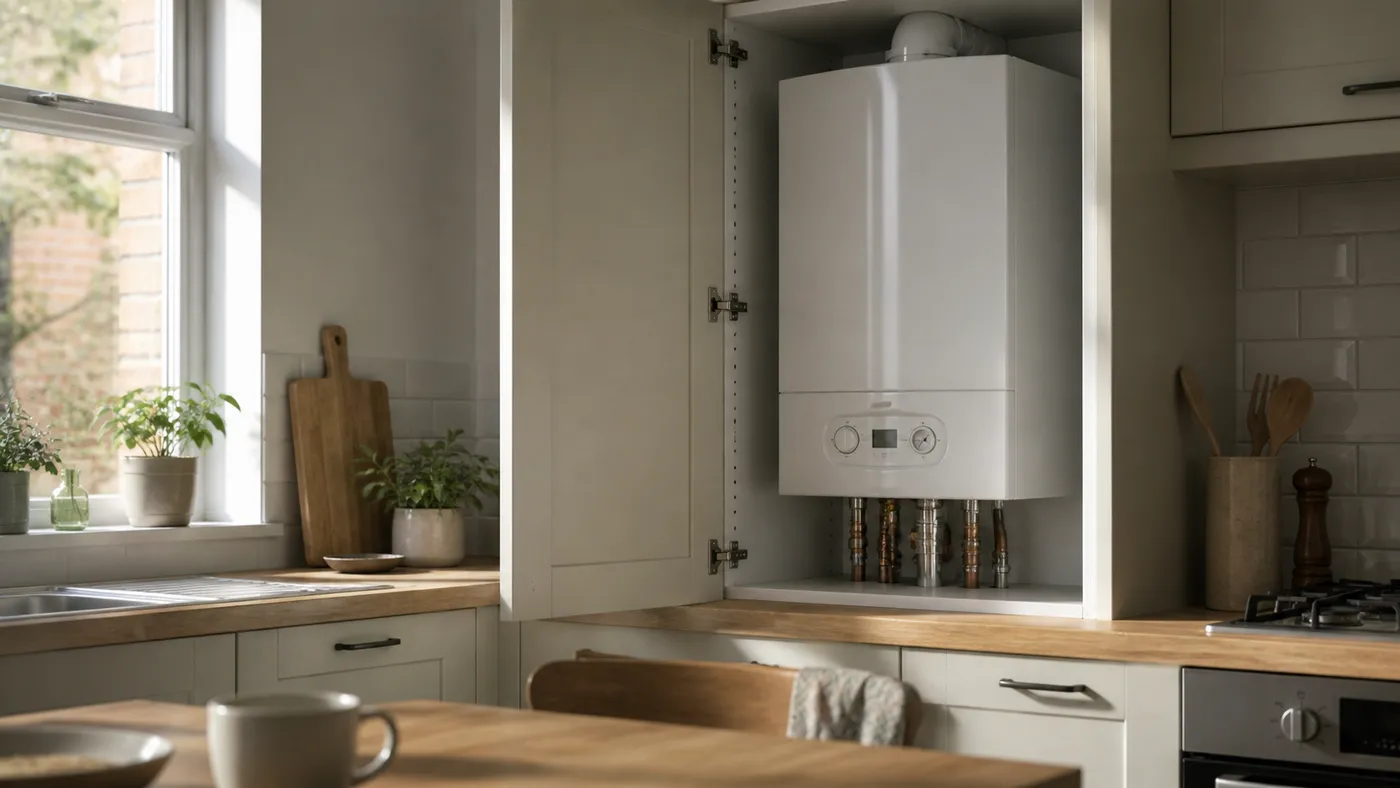
One box on the wall, no cylinder, no loft tank. Here is how a combi boiler actually works, where it shines and where it runs out of road.
A combi boiler, short for combination boiler, is a single unit that does two jobs: it heats the water in your radiators, and it heats your hot water on demand, straight from the mains, at the moment you turn on a tap. There is no hot water cylinder in an airing cupboard and no cold water tank in the loft. That is the whole idea, and it is why the combi is the most common boiler fitted in UK homes. Whether it is the right boiler for your home comes down mostly to how many people want hot water at the same time and how strong your incoming mains supply is.
How a combi boiler works
A combi runs two separate circuits through one boiler. The heating circuit is a sealed loop: the same water goes round the radiators and back to the boiler, kept at a set pressure you can read on the gauge on the front of the unit. The hot water side is not stored anywhere. Cold mains water comes in, passes through a heat exchanger inside the boiler, and leaves hot on its way to the tap or shower.
When you open a hot tap, the boiler senses the flow, fires up and switches its attention to hot water. If the heating was on, it pauses while you run the tap and resumes when you close it. On a cold morning with a shower running for fifteen minutes, the radiators simply wait. Most people never notice, but it is the first clue to how a combi prioritises.
What a combi does well
- Space. No cylinder and no loft tanks. In a London flat or a terraced house with a small airing cupboard, reclaiming that cupboard is often the main reason people choose one.
- Hot water that does not run out. Because water is heated as it flows, there is no tank to empty. A long shower stays hot as long as the boiler keeps firing.
- Mains-pressure hot water. Hot water arrives at close to the pressure of your cold mains, so showers are usually better than on an old gravity-fed system with a tank in the loft.
- No stored heat to lose. A cylinder slowly loses heat through its walls even when nobody is using it. A combi only heats what you use.
- Simpler system. Fewer components, no tank in the loft that can freeze or overflow, and less pipework to go wrong.
Where a combi struggles
Every combi has a ceiling on how much hot water it can deliver per minute. That ceiling is set by two things: the boiler's hot water output, and the flow rate and pressure of the mains coming into the house. The boiler cannot deliver more water than the mains supplies, however big it is.
In practice this shows up as one outlet at a time working well and two outlets sharing. Run a shower while someone fills the kitchen sink and the shower flow drops, and it can wobble in temperature. Two showers at once is where most combis in most London houses disappoint. Baths also fill more slowly than from a cylinder, because the combi is heating the water as it goes rather than releasing a tank that is already hot.
There is also no backup. A system with a cylinder usually has an electric immersion heater, so if the boiler fails you still have hot water. With a combi, a boiler breakdown means no heating and no hot water until it is fixed.
Combi, system or regular: the short version
A system boiler heats a separate hot water cylinder, usually an unvented one fed from the mains, so several outlets can run at once from stored hot water. A regular (also called conventional or heat-only) boiler works with a cylinder and tanks in the loft on an older gravity-fed layout. The full trade-off, including which suits which size of home, is set out in the combi, system and regular boiler comparison.
One point that confuses a lot of people: "combi" and "condensing" are not alternatives. Almost every gas combi fitted today is a condensing combi. The difference is explained in condensing boiler vs combi boiler.
Which homes a combi suits
A combi is usually the right answer when most of these are true:
- One bathroom, or a bathroom plus a cloakroom or en-suite that is rarely used at the same time.
- A household where overlapping showers are the exception rather than the morning routine.
- A decent mains flow rate at the property, measured rather than assumed.
- Space is tight, or you want the loft and airing cupboard back.
That describes a large share of London flats and smaller houses. It does not describe a four-bedroom house with two family bathrooms, or an upper-floor flat on a long, shared supply pipe where the mains flow is weak. In those homes a system boiler with a cylinder usually serves better, and it is worth reading combi vs system boiler for a growing family before deciding.
How combi boilers are sized
Combi outputs are quoted in kilowatts, and the figure that matters most is the hot water output, because heating a flowing stream of cold mains water instantly takes far more power than keeping radiators warm. That is why a combi for a given house is often rated higher than a heat-only boiler for the same house would be. Bigger is not automatically better, though: a combi sized well beyond what the mains can feed gives no extra hot water, and an oversized boiler short-cycles on the heating side. The common errors are covered in combi boiler sizing mistakes, and the boiler sizing guide walks through how output is worked out.
What fitting or replacing a combi involves
A like-for-like combi swap in the same position is the simplest boiler job there is. Changing from a system or regular boiler to a combi is a bigger piece of work, because the cylinder and tanks come out and the heating circuit is converted to a sealed system. That job has its own guide: changing to a combi boiler.
Either way, a proper installation includes checking the gas supply pipe is big enough for the boiler's output, routing the flue and condensate pipe correctly, cleaning the existing system and fitting a magnetic filter, commissioning the boiler and completing the Benchmark checklist, and notifying the work under Building Regulations. In England, replacing a combi also has to meet the Boiler Plus rules on controls, which is why a basic on/off timer on its own is not enough on a new install.
Getting the right answer for your home
The two numbers that decide whether a combi will work for you are how many outlets you need running at once and what your mains actually delivers. Both are checked on a survey. If you are weighing up a combi, our combi boiler replacement service starts with a free survey and ends with a fixed written quote, and if a combi is the wrong fit for the house, you will be told so before anything is priced. Book a free survey to get the flow rate measured and a straight recommendation.
Frequently asked questions
Does a combi boiler need a water tank?
No. A combi heats water directly from the mains as you use it, so there is no hot water cylinder and no cold water storage tank in the loft. The heating side is a sealed system topped up from the mains, so there is no feed and expansion tank either.
Can a combi boiler run two showers at once?
Sometimes, but it is where most combis struggle. The hot water flow is limited by the boiler's output and by the mains flow rate into the house, so two showers running together share that flow and both drop. If simultaneous showers are a daily need, a system boiler with a cylinder is usually the better choice.
Is a combi boiler gas or electric?
Most combi boilers in UK homes run on mains gas. Electric combi boilers do exist and can suit flats with no gas supply, but their hot water flow is much lower than a gas combi's. The trade-off is covered in our article on combi versus electric boilers for London flats.
Do I lose hot water if a combi boiler breaks down?
Yes. With no cylinder there is no immersion heater to fall back on, so a combi breakdown means no heating and no hot water until it is repaired. Homes with a cylinder usually keep hot water through the immersion heater.
Is a combi boiler right for a two-bathroom house?
It depends on how the bathrooms are used and on the mains flow rate. If the second bathroom is rarely used at the same time as the first and the mains is strong, a combi can work well. If both are in use every morning, a system boiler with an unvented cylinder normally gives a better result.